About this year
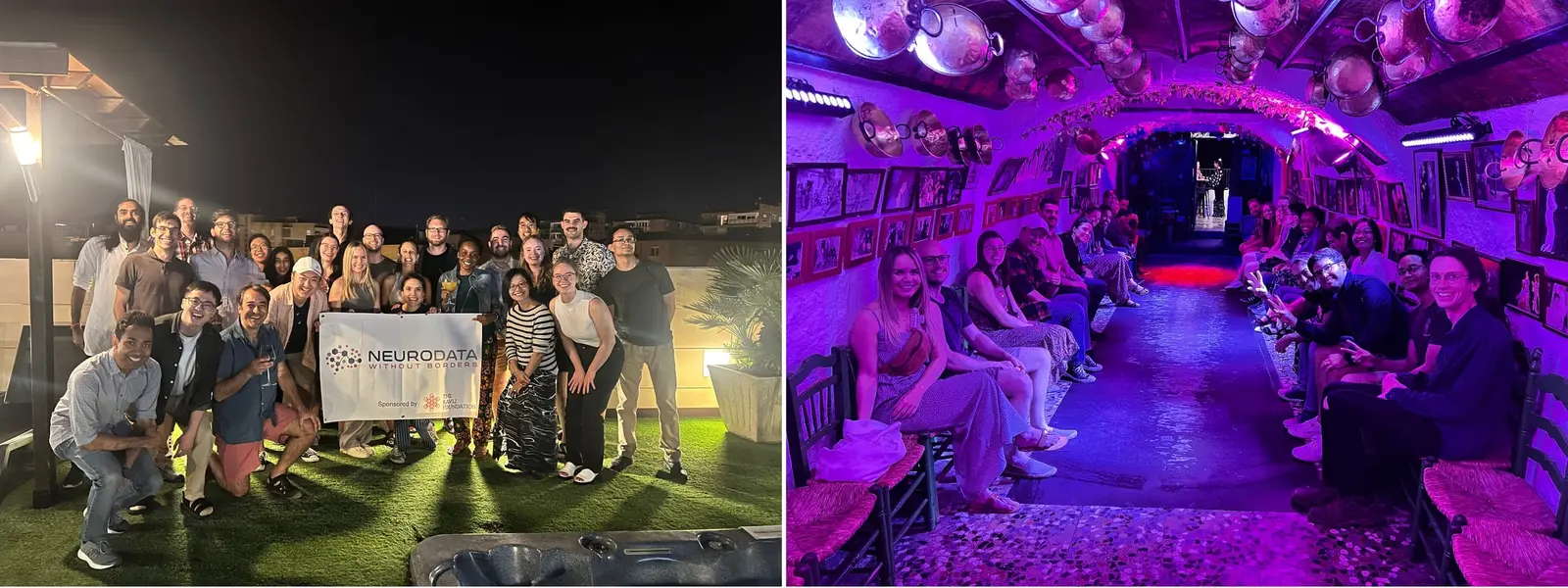
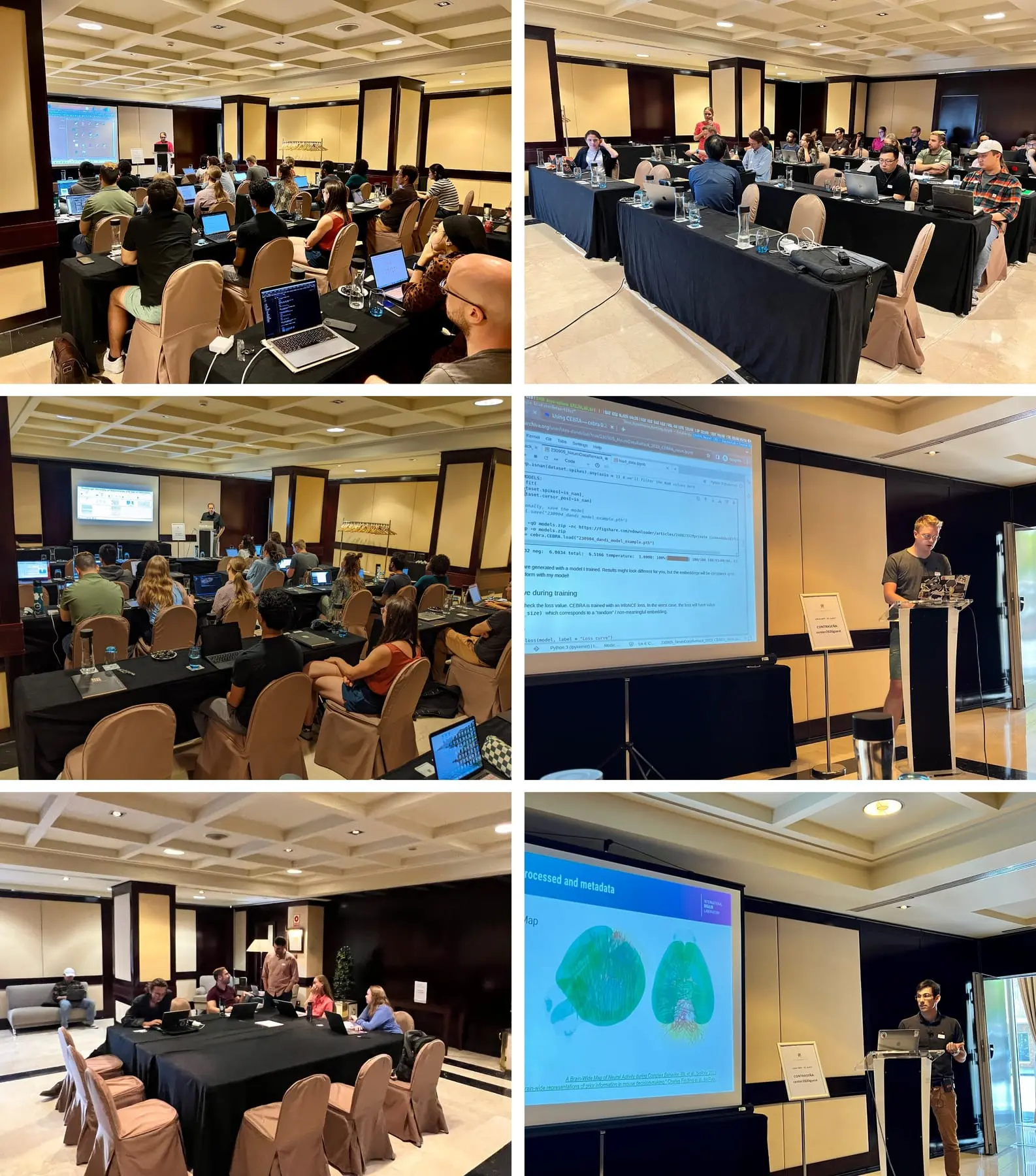
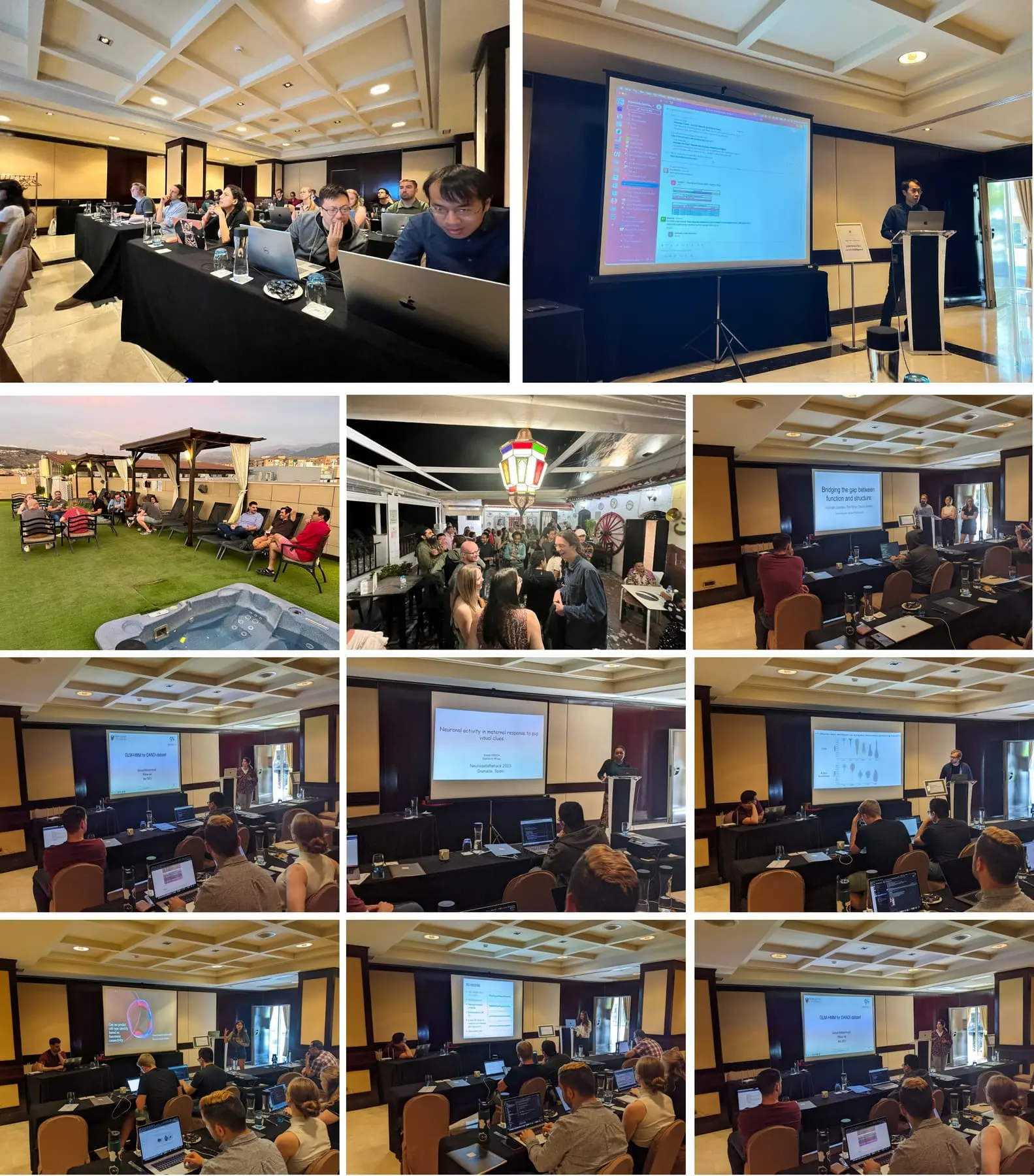
NeuroDataReHack 2023 was held in Granada, Spain, as a satellite of the IBRO World Congress, with the goal of making the event accessible to participants who might not otherwise have the opportunity to attend. It drew 31 participants from 25 institutions in 15 countries, the most international cohort of any installment. A virtual Open Neurodata Showcase before the workshop let registrants meet the contributors behind the datasets on DANDI.
Following the event, participants were invited to apply for a Kavli Foundation Neurodata Discovery Award to continue projects begun at the workshop.
Activity of single neurons during a declarative memory task
Fatmaalzahraa Aboalasaad
How the activity of single neurons during a declarative memory task (DANDI:000004) correlates with the encoding, retrieval, and consolidation processes of memory formation.
Analyzing spatiotemporal patterns from ECoG recordings
Tim Näher, Lisa Bastian
Analyze spatiotemporal patterns from ECoG recordings to identify patterns of neural activity in the sensorimotor cortex that correspond to different speech sounds and articulatory movements.
Bridging the gap between function and structure
Hannah Gooden, Victoria Rose, Daniel Xenes
Continued secondary analysis of the MICrONS dataset, including the two-photon calcium imaging hosted on the DANDI archive and the co-registered electron microscopy data hosted in the BossDB archive.
Contribution of physiological rhythms (respiration) to neural population geometries
Araceli Ramirez Cardenas
Disparities in parental response to visual and auditory cues from pups
Eberechi Wogu
Early maternal care is essential for the development and survival of offspring, and multiple sensory modalities such as visual, olfactory and auditory cues from the pups trigger parental responses.
IBL Brain-wide map: Adaptation and history biases across the brain hierarchy
Melanie Tschiersch
Analyze the IBL Brain-wide map to understand adaptation (repulsion from the previous stimulus) versus serial dependence (attraction to the previous stimulus) in visual processing versus higher-order cognitive areas.
Identifying homologies and diversifications of intrinsic physiological properties in rodents
Felipe Yáñez
Systematically assess the variability of intrinsic physiological properties of GABAergic interneurons across the cortical depth of rat barrel cortex and mouse visual and motor cortices.
Identifying latent states in decision-making tasks to uncover choice strategies
Zeinab Mohammadi
Rodent decision-making relies on distinct latent states which switch on a timescale of tens to hundreds of trials, and different brain regions' contributions to state-dependent strategies remain an important open problem.
Integrating Rule-Based Modulation and Context-Dependent Sensorimotor Adaptation in Cortical Areas
Tenghai Long
Explore the integration of rule-based modulation and context-dependent sensorimotor adaptation across cortical areas by analyzing electrophysiological data from DANDI:000239 and DANDI:000232.
Investigating neural representations of visual stimuli during encoding and retrieval
Sofia Raglio
Investigate how different the neural representation of visual stimuli in the medial temporal lobe is during encoding and retrieval.
Investigating the relationship between neuronal activity patterns and behavior in humans during decision-making tasks
Kshitij Kumar
Analyzing DANDI:000397 to investigate the relationship between neuronal activity patterns and behavior in humans during decision-making tasks.
Modulation of spontaneous neural activity by arousal
Martynas Dervinis
Neural activity can be broadly divided into fast and slow types; slow activity on the timescale of seconds is thought to underlie attentional processes and brain state transitions during wakefulness.
Neural trajectories in the anterior cingulate cortex during reward
Olivier Winter, Petrina Lau
Compute neural trajectories from raw AP data in the anterior cingulate cortex of the mouse around the reward event in the IBL task.
Neuronal ensembles in different brain regions
Ricardo Velázquez Contreras
Neuronal ensembles, as originally proposed by Donald Hebb, represent groups of neurons that display coordinated and alternating activity patterns.
Normative Models of Cognitive Representations
Will Dorrell
Testing normative theories of neural representation, which explain tuning curves as the optimum of a set of goals and constraints, against experimental data on DANDI.
Predicting cell type identity based on functional connectivity
Margaret Conde Paredes
Study task-specific neural trajectories and covariance in primate motor cortex electrophysiology data to gain insights into the neural mechanisms underlying motor control and movement generation.
The effect of different analysis techniques on the detection of fNIRS responses
Ishara Paranawithana
Investigate the impact of different analysis procedures on the morphology, detection, and lateralization of fNIRS responses in the motor cortex during a finger-tapping task (DANDI:000122).
Transcriptomic profiles and action potentials in GABAergic interneurons in the mouse visual cortex
Raymond L Wang
Understanding the relationship between transcriptomic profiles and action potentials in GABAergic interneurons in the mouse visual cortex using the Allen Institute Patch-seq dataset.